🧮 Algebra Adventurer
🕹️ How to Play
-
Read the equation displayed in the panel at the bottom of the screen.
-
Choose the correct value of x from the 4 answer options.
-
Each correct answer extends the bridge so your hero can cross.
-
Answer all 6 problems in a level to advance to the next.
-
Worlds progress from x + a = b through two-step, subtraction, variable-on-both-sides, and bracket equations.
🧩 Skills You'll Build
📖 About This Game
Algebra Adventurer frames equation solving as a literal bridge-building challenge: the hero can only cross the gap when the player correctly solves each equation, and the bridge visibly grows with every right answer. Five worlds introduce equation types in a carefully scaffolded sequence — Bridge Builder uses one-step addition (x + a = b), Tower Climber introduces two-step equations (ax + b = c), Cave Explorer adds subtraction (ax − b = c), Sky Islands presents variable-on-both-sides equations, and Final Fortress requires solving bracket expressions. All 80 levels generate equations procedurally, guaranteeing integer solutions and automatically scaling difficulty within each world so learners are always challenged but never overwhelmed.
Learning outcomes: Algebra, Linear Equations, and Problem Solving development through engaging, self-paced gameplay.
What Your Child Will Learn
Students progress from one-step equations to multi-step problems with brackets, building algebraic fluency through consistent practice. They learn to isolate a variable by performing the same operation on both sides, a fundamental principle that extends to every branch of algebra. By the Final Fortress world, students can confidently solve bracket expressions like 2(x + 3) = 14 and explain their reasoning step by step.
Skills Developed in Detail
- Algebra: Each world introduces equation solving as purposeful problem-solving rather than symbol manipulation, helping students understand why algebraic methods work rather than just memorizing steps.
- Linear Equations: All 80 levels guarantee integer solutions, keeping the arithmetic clean so students can focus on the algebraic thinking without fractions getting in the way.
- Problem Solving: The bridge metaphor — the hero can only cross when you solve the equation — makes each correct answer feel earned rather than arbitrary.
- Mathematical Reasoning: Procedurally generated equations mean students can’t memorize answers between sessions; they have to apply their reasoning every time.
Tips for Parents
Encourage your student to say the steps aloud: “I need x alone, so I subtract 3 from both sides.” Verbalizing algebra bridges the gap between procedural fluency and genuine understanding. If they’re stuck in Sky Islands or Final Fortress, ask them to sketch the equation on paper first — moving between digital and physical representations reinforces the concept from multiple angles.
How Teachers Can Use This in the Classroom
Algebra Adventurer works well as a differentiated practice station during algebra units in grades 6–8. The five worlds map to natural lesson checkpoints: assign Bridge Builder after introducing one-step addition equations, then unlock each subsequent world as you teach the corresponding equation type. The procedural generation means early finishers get fresh problems without a separate assignment.
Curriculum Alignment
- CCSS.MATH.CONTENT.6.EE.B.7 — Solve real-world problems by writing and solving equations of the form x + p = q
- CCSS.MATH.CONTENT.7.EE.B.4 — Use variables to represent quantities and solve simple equations and inequalities
- CCSS.MATH.CONTENT.8.EE.C.7 — Solve linear equations in one variable, including equations with variables on both sides
Why It Matters
Linear equations are the central concept of middle school mathematics and the gateway to every STEM pathway. Students who can solve them fluently handle pre-calculus, physics, economics, and computer science with far greater ease. More importantly, the logical structure of “what do I do to both sides to isolate the unknown” trains a transferable reasoning skill that applies well beyond math class.
More Math & Numbers Games
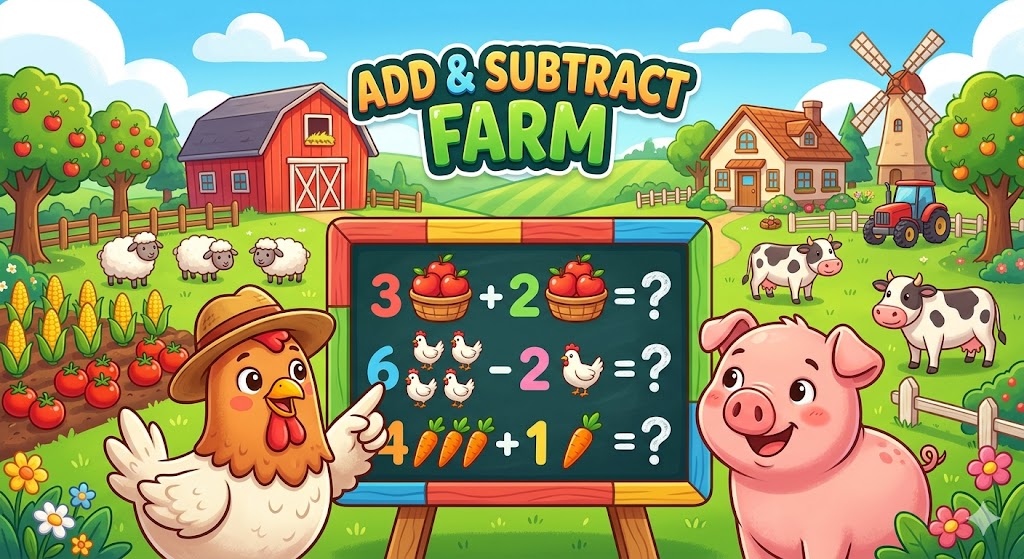
Add & Subtract Farm
Learn addition and subtraction through farm-themed visual puzzles. For ages 5-7, builds number sense and word problem skills. 10-15 min.
Coin Collector
Practice money math by collecting coins from pennies to quarters. For ages 5-7, builds addition and place value skills. 10-15 min.
Coordinate Conquest
Explore the coordinate plane by plotting points across all four quadrants. For ages 11-15, builds graphing and linear equation skills. 15-20 min.
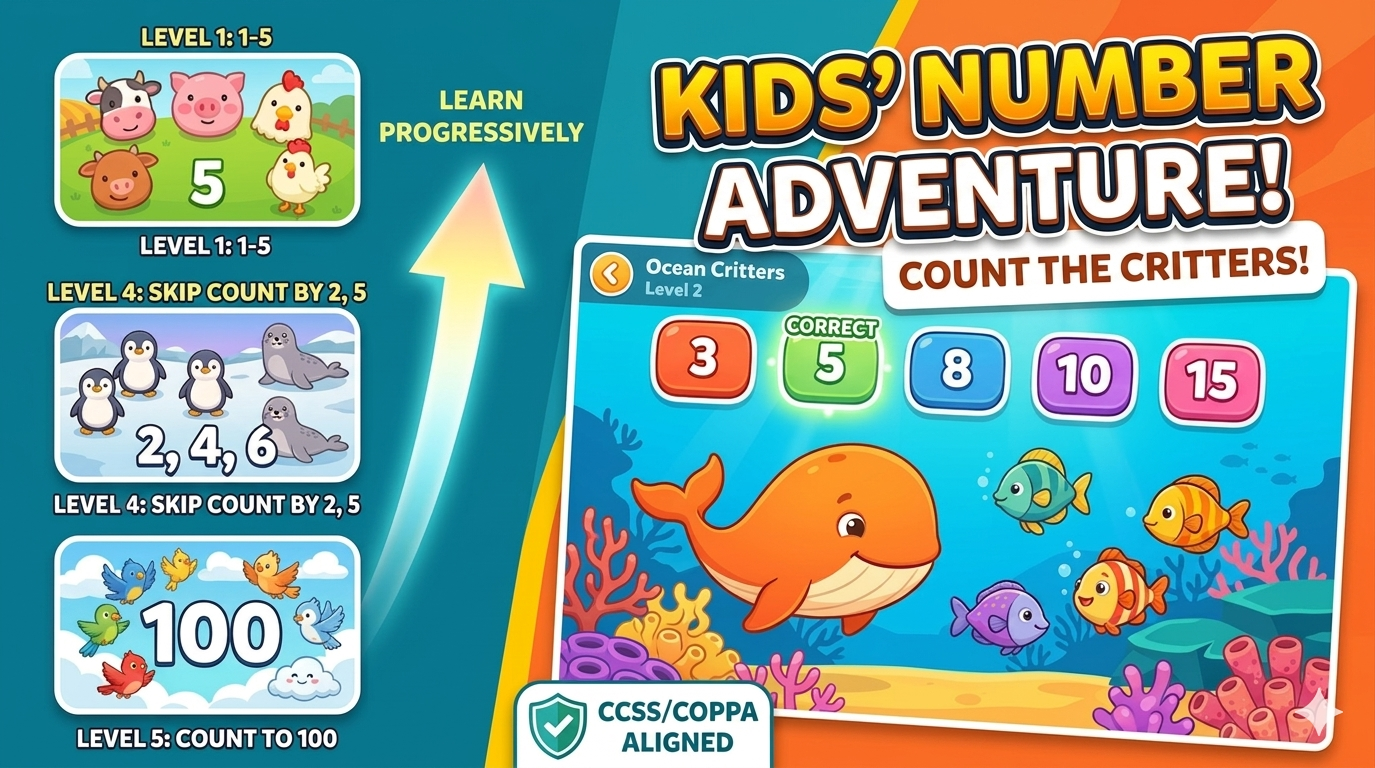
Counting Critters
Count colorful animals across five magical habitats, from 1-5 to skip-counting by 10s. For ages 5-7, builds counting and number recognition. 10-15 min.