🐾 Counting Critters
🕹️ How to Play
-
Look at the animals in their habitat and count them carefully.
-
Tap the number button that shows how many animals you see.
-
Complete 5 correct answers to move to the next level!
Game loading...
🧩 Skills You'll Build
📖 About This Game
Counting Critters sends young learners on a number adventure through five magical animal habitats. Starting with simple farm counting (1-5), kids progress through ocean creatures (1-10), jungle animals (10-20), and eventually master skip-counting by 2s and 5s in the Arctic before counting by 10s all the way to 100 in the Sky World. Colorful emoji animals make every scene a delight to explore.
Learning outcomes: Counting, Number Recognition, and Skip Counting development through engaging, self-paced gameplay.
What Your Child Will Learn
Children build counting fluency from one-to-one correspondence (pointing at each animal as they count) through organized counting strategies, subitizing small groups at a glance, and finally skip-counting by 2s, 5s, and 10s. By the Sky World, students count to 100 by 10s — a milestone that signals readiness for place value concepts. Seeing numbers embedded in vivid animal habitats makes the abstract sequence of counting words concrete and meaningful.
Skills Developed in Detail
- Counting: One-to-one correspondence — tagging each item once and only once — is the foundational counting principle, and the habitat scenes create natural opportunities to practice it with visual groupings that vary each time.
- Number Recognition: Seeing a number word, a written numeral, and a visual quantity simultaneously across many sessions builds robust number recognition — students stop guessing and start knowing.
- Skip Counting: Counting by 2s and 5s with Arctic creatures introduces the efficiency of grouping, which is the conceptual foundation for multiplication — a major mathematical idea children will encounter in second and third grade.
- Subitizing: The smaller groups in early levels are designed to support subitizing — the automatic recognition of quantities up to 5 without counting — a key early numeracy benchmark.
Tips for Parents
Ask your child to count objects at home the same way — “Can you count how many shoes are by the door? Can you count them by 2s?” Finding real animals to count on nature walks or in picture books connects the game’s learning to lived experience. When your child reaches the skip-counting levels, practice skip-counting in the car by 2s or 5s — this builds number fluency through repetition in a low-pressure context.
How Teachers Can Use This in the Classroom
Counting Critters supports kindergarten and early first grade math instruction across a whole-year span. Use the farm habitat (1–5) in the fall as a counting readiness check, ocean critters (1–10) during early counting instruction, and the skip-counting worlds as supplementary practice when the class moves into grouped counting and early multiplication readiness. The five-correct-to-advance format makes progress visible without drawing attention to those who need more practice.
Curriculum Alignment
- CCSS.MATH.CONTENT.K.CC.A.1 — Count to 100 by ones and by tens
- CCSS.MATH.CONTENT.K.CC.B.4 — Understand the relationship between numbers and quantities; connect counting to cardinality
- CCSS.MATH.CONTENT.2.NBT.A.2 — Count within 1000; skip-count by 5s, 10s, and 100s
Why It Matters
Counting is the first great mathematical achievement of early childhood, and it encompasses far more than reciting number words — it requires understanding that each count corresponds to one object, that the last number said tells the total, and that numbers represent stable, ordered quantities. Children who develop strong counting foundations enter first grade prepared for addition and subtraction, and the skip-counting skills they gain here become the cognitive scaffolding for multiplication in third grade.
More Math & Numbers Games
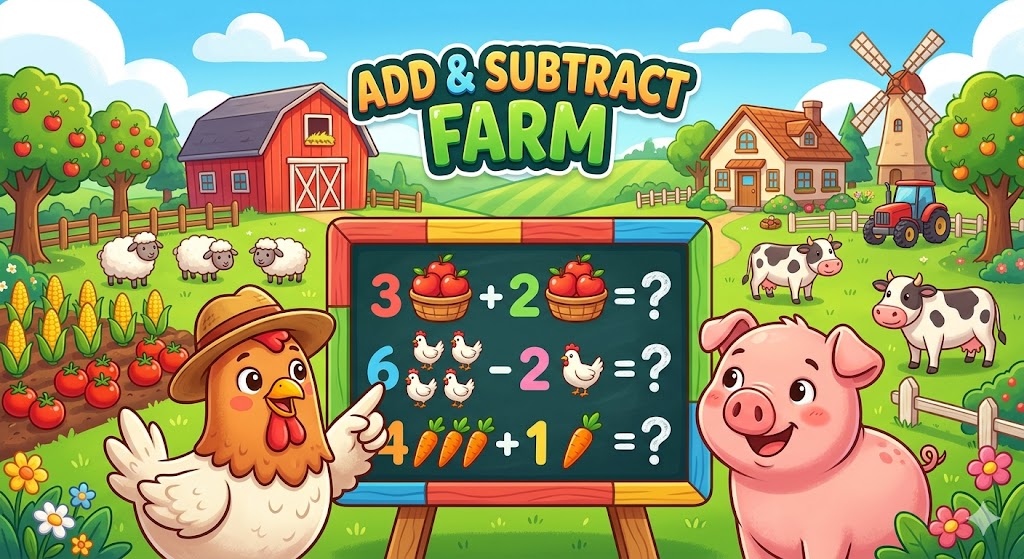
Add & Subtract Farm
Learn addition and subtraction through farm-themed visual puzzles. For ages 5-7, builds number sense and word problem skills. 10-15 min.

Algebra Adventurer
Master algebra by solving linear equations to build bridges across 5 worlds. For ages 11-15, builds problem solving and mathematical reasoning. 15-20 min.
Coin Collector
Practice money math by collecting coins from pennies to quarters. For ages 5-7, builds addition and place value skills. 10-15 min.
Coordinate Conquest
Explore the coordinate plane by plotting points across all four quadrants. For ages 11-15, builds graphing and linear equation skills. 15-20 min.