📍 Coordinate Conquest
🕹️ How to Play
-
Read the coordinate instruction.
-
Click the correct position on the grid.
-
Master all quadrants and graphing!
🧩 Skills You'll Build
📖 About This Game
Conquer the coordinate plane one point at a time! Starting with simple Quadrant I plotting, you’ll progress through all four quadrants, distance calculations, and ultimately graphing linear equations in slope-intercept form. Coordinate Conquest makes abstract math tangible by letting you click directly on the grid to place your answers. Five zones of increasing challenge build the skills you need for algebra and beyond.
Learning outcomes: Coordinate Plane, Graphing, and Plotting Points development through engaging, self-paced gameplay.
What Your Child Will Learn
Students master the coordinate plane systematically — starting in Quadrant I, adding negative values for Quadrant II, then extending to all four quadrants before tackling distance calculations and slope-intercept graphing. By the final zone, students can plot any point (x, y) in any quadrant, calculate the distance between two points on a horizontal or vertical line, and graph a linear equation in slope-intercept form. These are essential algebra and geometry skills introduced visually.
Skills Developed in Detail
- Coordinate Plane: Clicking directly on the grid to answer questions makes the coordinate plane a physical space rather than an abstract symbol system — students develop genuine spatial intuition for location.
- Graphing: The progression from plotting individual points to graphing full linear equations mirrors the curriculum sequence in grades 6–8, making this game a powerful preview and review tool.
- Plotting Points: Accuracy in point placement requires understanding that (3, 5) is different from (5, 3) — a crucial distinction that students often confuse, which direct grid interaction resolves naturally.
- Linear Equations: The slope-intercept zone introduces y = mx + b in the most concrete possible way: students plot three points and connect them, seeing the line emerge as a pattern in plotted data.
Tips for Parents
Play a coordinate game in real life: draw a simple grid on paper, label the axes, and take turns giving each other coordinate pairs to mark. Connecting the digital skill to physical drawing builds the spatial understanding. Ask “What does the x-coordinate tell you? What does the y-coordinate tell you?” — confirming that students understand each component rather than guessing as a unit.
How Teachers Can Use This in the Classroom
Coordinate Conquest is an outstanding review and practice tool for middle school math teachers. The five zones map neatly to the instructional sequence for coordinate plane: assign Zone 1 (Quadrant I) after introducing the concept, then unlock Zones 2–5 as you teach negative coordinates, all four quadrants, and eventually linear graphing. It functions equally well as a bell-ringer, homework, or station activity.
Curriculum Alignment
- CCSS.MATH.CONTENT.5.G.A.1 — Use a pair of perpendicular number lines, called axes, to define a coordinate system
- CCSS.MATH.CONTENT.6.NS.C.6 — Understand a rational number as a point on the number line; extend number line diagrams to the coordinate plane
- CCSS.MATH.CONTENT.8.EE.B.5 — Graph proportional relationships, interpreting the unit rate as the slope of the graph
Why It Matters
The coordinate plane is the foundation of analytic geometry, algebra, data visualization, and calculus. Students who can fluently move between coordinate pairs and their grid locations handle graphing calculators, data charts, and spatial programming tasks with confidence. More broadly, coordinate thinking — locating a point relative to two reference axes — maps directly onto navigation, mapping, computer graphics, and geographic information systems, making it one of the most widely applicable mathematical concepts taught in middle school.
More Math & Numbers Games
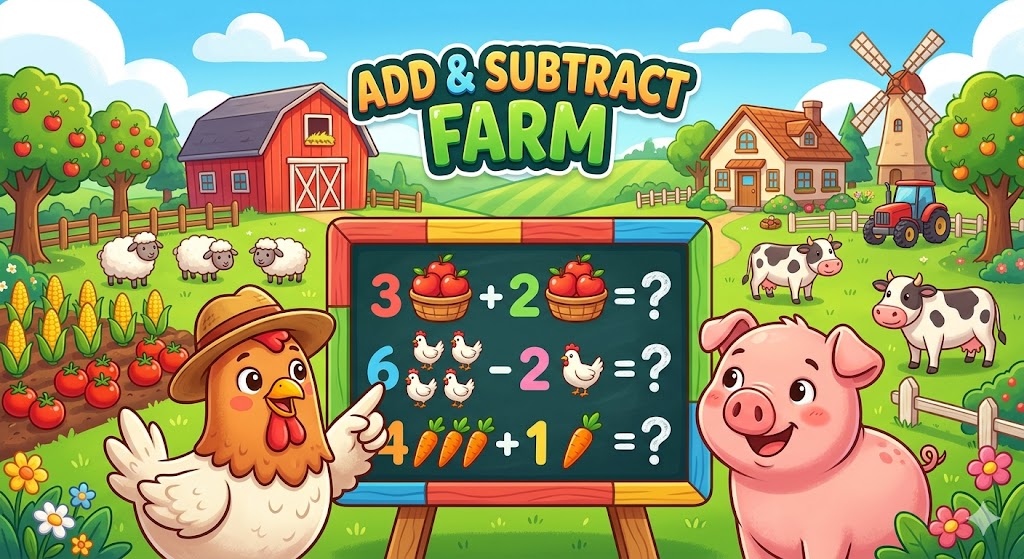
Add & Subtract Farm
Learn addition and subtraction through farm-themed visual puzzles. For ages 5-7, builds number sense and word problem skills. 10-15 min.

Algebra Adventurer
Master algebra by solving linear equations to build bridges across 5 worlds. For ages 11-15, builds problem solving and mathematical reasoning. 15-20 min.
Coin Collector
Practice money math by collecting coins from pennies to quarters. For ages 5-7, builds addition and place value skills. 10-15 min.
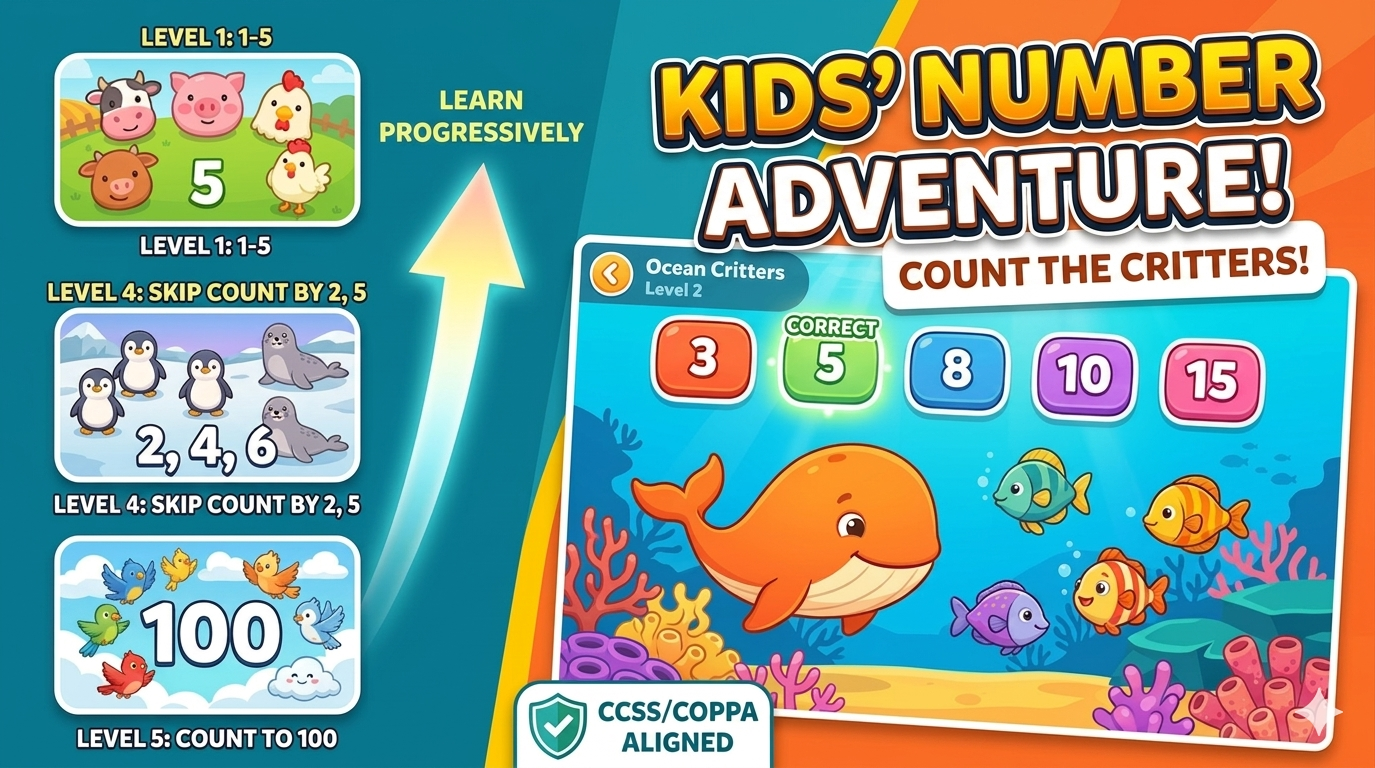
Counting Critters
Count colorful animals across five magical habitats, from 1-5 to skip-counting by 10s. For ages 5-7, builds counting and number recognition. 10-15 min.