🪙 Coin Collector
🕹️ How to Play
-
Read the target amount shown at the top.
-
Tap coins to add them to your total.
-
Press Submit when your total matches the target!
Game loading...
🧩 Skills You'll Build
📖 About This Game
Coin Collector turns every young learner into a money whiz! Begin your journey with simple penny counting, then discover the power of nickels and dimes as you build toward dollar-sized totals. The final mixed-coin stage challenges players to combine pennies, nickels, dimes, and quarters to hit targets up to five dollars. Tap coins, watch your total grow, and hit Submit when you reach the target amount.
Learning outcomes: Money, Addition, and Place Value development through engaging, self-paced gameplay.
What Your Child Will Learn
Children learn to recognize all four common US coins by appearance and value, count mixed-coin collections efficiently, and build totals up to five dollars. Along the way they develop an understanding of place value through the lens of money — a dime is ten pennies, a quarter is five nickels — making the abstract concept of “ten ones equal one ten” feel concrete and purposeful. By the mixed-coin stage, students can mentally skip-count by 25s and 10s, a valuable arithmetic shortcut.
Skills Developed in Detail
- Money: Students recognize coin values, not just appearances, and learn to combine them efficiently — choosing to count quarters before nickels before pennies because starting with the largest denomination is faster.
- Addition: Each tap adds a new coin value to a running total, giving students immediate feedback on their cumulative arithmetic and building mental addition fluency in a meaningful context.
- Place Value: Understanding that 10 pennies equal 1 dime, and 10 dimes equal 1 dollar, is place value made visible — the abstract base-ten system becomes a concrete set of coins.
- Problem Solving: Hitting a specific target amount often requires strategic selection — do I use three dimes or six nickels? — building flexible thinking about equivalent quantities.
Tips for Parents
Give your child a small collection of real coins and ask them to make a specific amount using as few coins as possible, then as many as possible. This connects the game to tangible objects and introduces the idea that there’s often more than one correct answer to a math problem. At the checkout line, invite your child to calculate the total or estimate whether a bill will cover the purchase.
How Teachers Can Use This in the Classroom
Coin Collector is a strong math center activity for grades 1–2 during money units. The staged progression from single-coin practice to mixed-coin challenges maps cleanly to a two-to-three week money curriculum. Students who finish early can work ahead to the dollar-level stages, while students who need more practice can revisit earlier coin stages without losing confidence.
Curriculum Alignment
- CCSS.MATH.CONTENT.2.MD.C.8 — Solve word problems involving dollar bills, quarters, dimes, nickels, and pennies using dollar and cent symbols appropriately
- CCSS.MATH.CONTENT.1.NBT.B.2 — Understand that the two digits of a two-digit number represent amounts of tens and ones
- CCSS.MATH.CONTENT.1.OA.A.1 — Use addition and subtraction within 20 to solve word problems involving situations of adding to, taking from, putting together
Why It Matters
Money is math made real. Children who can count coins confidently have demonstrated that they understand place value, addition, and practical reasoning all at once. These skills matter at the grocery store, at lemonade stands, and eventually in understanding budgets, wages, and financial planning. Building solid money math in early elementary school creates a foundation for financial literacy that compounds over a lifetime.
More Math & Numbers Games
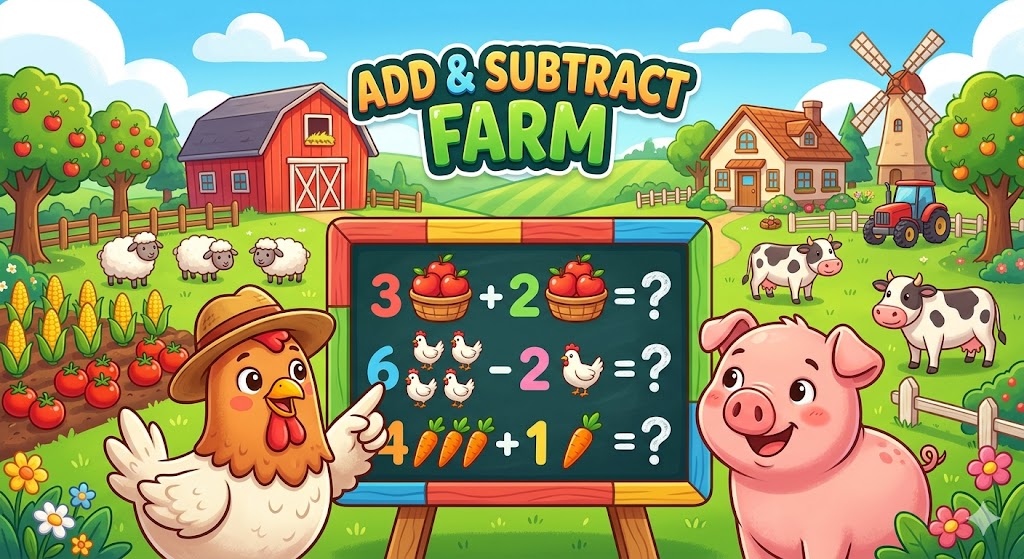
Add & Subtract Farm
Learn addition and subtraction through farm-themed visual puzzles. For ages 5-7, builds number sense and word problem skills. 10-15 min.

Algebra Adventurer
Master algebra by solving linear equations to build bridges across 5 worlds. For ages 11-15, builds problem solving and mathematical reasoning. 15-20 min.
Coordinate Conquest
Explore the coordinate plane by plotting points across all four quadrants. For ages 11-15, builds graphing and linear equation skills. 15-20 min.
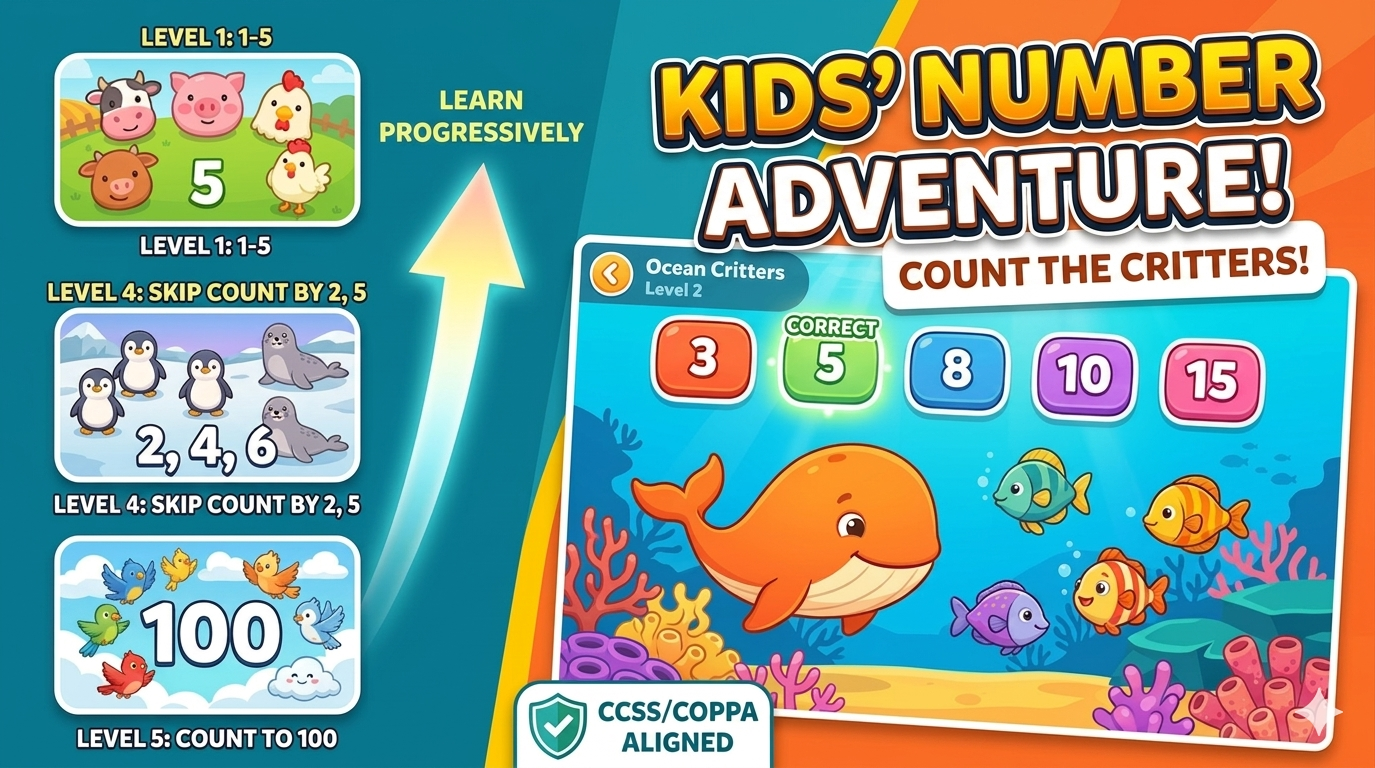
Counting Critters
Count colorful animals across five magical habitats, from 1-5 to skip-counting by 10s. For ages 5-7, builds counting and number recognition. 10-15 min.