💰 Financial Empire
🕹️ How to Play
-
Read the business situation and your budget.
-
Choose the smartest financial decision.
-
Grow your money across 5 rounds!
🧩 Skills You'll Build
📖 About This Game
From a humble lemonade stand to a real estate empire — every great business starts with smart decisions! Financial Empire challenges you to manage budgets, calculate profit and loss, and make strategic choices across four business types. Learn real-world financial math while building your fortune across 40 levels.
Learning outcomes: Financial Literacy, Budgeting, and Profit/Loss development through engaging, self-paced gameplay.
What Your Child Will Learn
Students work through the progression of financial complexity that mirrors real business growth: from a lemonade stand’s simple income-minus-expenses calculation, through a food truck’s inventory and daily revenue management, to a retail store’s pricing and profit-margin decisions, and finally a real estate investment’s long-term return analysis. By the end, students can calculate profit and loss, understand what a budget is and why it matters, and evaluate whether a financial decision is smart based on actual numbers.
Skills Developed in Detail
- Financial Literacy: Each scenario uses real financial vocabulary — revenue, expense, profit, loss, budget, investment, return — in context, giving students an authentic financial language they can use in real conversations.
- Budgeting: Budget-constraint scenarios force students to prioritize: if you only have $500 and the options cost more than that total, what do you choose? This is the essential discipline of every personal and business budget.
- Profit/Loss: Calculating profit (revenue minus expenses) and understanding why a business with high revenue can still lose money (due to high expenses) is a critical financial concept that even many adults misunderstand.
- Business Math: Percentage markup, break-even analysis, and return on investment appear in the higher levels, giving mathematically curious students an authentic application for percentages and multi-step arithmetic.
Tips for Parents
Use a real small purchase as a financial literacy exercise together: “If we sell lemonade for $1 per cup and each cup costs us $0.25 to make, how many cups do we need to sell to make $10 profit?” These parallel calculations connect the game to real entrepreneurial thinking. Ask your teenager “Is this a want or a need?” for any discretionary purchase — financial literacy starts with this distinction.
How Teachers Can Use This in the Classroom
Financial Empire is a strong supplementary activity for grades 6–8 math classes during units on percentages, financial literacy, and real-world application. Each business stage can serve as an applied math problem set, with students calculating answers on paper before verifying against the game. The game also works well in an economics or social studies class to introduce concepts like supply and demand, market pricing, and entrepreneurship.
Curriculum Alignment
- CCSS.MATH.CONTENT.6.RP.A.3c — Find a percent of a quantity as a rate per 100; solve problems involving finding the whole, given a part and the percent
- CCSS.MATH.CONTENT.7.RP.A.3 — Use proportional relationships to solve multistep ratio and percent problems
- National Standards for Financial Literacy (NGPF) — Earning Income, Spending, Saving, and Investing
Why It Matters
Financial literacy is one of the most significant gaps in American education, and the consequences are lasting: student debt crises, retirement under-saving, and poor credit management trace directly to a lack of foundational financial education. Students who understand profit, loss, budgeting, and investment before they take their first job are better equipped to make smart decisions from day one. Financial Empire turns these concepts into an engaging game precisely during the window — middle school — when financial curiosity is high and habits are being formed.
More Math & Numbers Games
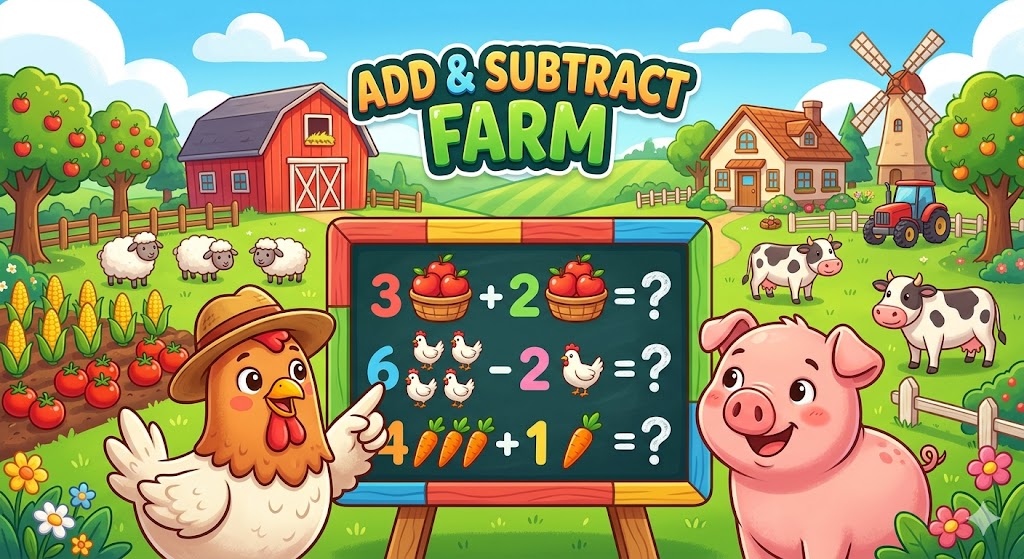
Add & Subtract Farm
Learn addition and subtraction through farm-themed visual puzzles. For ages 5-7, builds number sense and word problem skills. 10-15 min.

Algebra Adventurer
Master algebra by solving linear equations to build bridges across 5 worlds. For ages 11-15, builds problem solving and mathematical reasoning. 15-20 min.
Coin Collector
Practice money math by collecting coins from pennies to quarters. For ages 5-7, builds addition and place value skills. 10-15 min.
Coordinate Conquest
Explore the coordinate plane by plotting points across all four quadrants. For ages 11-15, builds graphing and linear equation skills. 15-20 min.