🍕 Fraction Pizza Factory
🕹️ How to Play
-
Read the customer's order shown at the top of the screen.
-
For identify levels: choose the correct fraction that matches the highlighted pizza slices.
-
For fill levels: tap pizza slices to fill the right number of sectors, then press Done.
-
For compare levels: choose which pizza shows the larger fraction.
-
For add levels: solve the fraction addition and pick the correct answer.
🧩 Skills You'll Build
📖 About This Game
Fraction Pizza Factory makes fractions deliciously tangible. Players run a busy pizza kitchen where every customer order involves a fraction — from identifying what fraction is highlighted, to filling exactly 3/4 of a pizza with toppings, to comparing two fractions side by side, and finally adding fractions together. The 70 progressive levels move naturally from simple halves and quarters through sixths and eighths, building solid fraction number sense through visual, hands-on interaction.
Learning outcomes: Fractions, Number Sense, and Comparing Fractions development through engaging, self-paced gameplay.
What Your Child Will Learn
Students move through fractions systematically — from recognizing what a fraction means (3 out of 4 parts), to filling a given fraction by selecting slices, to comparing two fractions side by side, to adding fractions with like denominators. By level 70, students have a solid visual and procedural understanding of fractions from halves through eighths, and can explain why 3/4 is greater than 2/4 by reasoning about the number of equal parts rather than just comparing numerals.
Skills Developed in Detail
- Fractions: The visual pizza model is one of the most effective tools for building genuine fraction understanding — students see that a fraction represents equal parts of a whole, not just a notation with two numbers.
- Number Sense: Working with halves, thirds, quarters, sixths, and eighths builds an intuitive feel for the relative size of fractions that supports all future fraction operations and comparison.
- Comparing Fractions: Comparing two pizza images side by side makes fraction comparison visual before it becomes procedural — students can see that 3/4 covers more of the pizza than 2/4 before they learn the formal rule.
- Adding Fractions: The addition levels introduce fraction addition through the pizza model — 1/4 + 2/4 = 3/4 is visible as three slices out of four — connecting the visual to the procedural in a natural, memorable way.
Tips for Parents
Cut a real pizza or a piece of paper into equal parts and practice the same activities: “Show me 3/4 of the pizza. Which is more — 1/4 or 3/4? If we have 1/4 and add another 2/4, how much do we have?” Physical manipulation of fraction pieces is one of the most powerful tools for building fraction understanding, and the game prepares children to work with real fractions confidently.
How Teachers Can Use This in the Classroom
Fraction Pizza Factory maps well to grades 3–4 fractions curriculum. The identify and fill levels serve as strong introduction activities, the compare levels work as practice after comparing fractions is taught, and the add levels function as a bridge to fraction addition instruction. The game is well-suited as a math center activity during differentiated instruction, since students advance at their own pace through the 70 levels.
Curriculum Alignment
- CCSS.MATH.CONTENT.3.NF.A.1 — Understand a fraction 1/b as the quantity formed by 1 part when a whole is partitioned into b equal parts
- CCSS.MATH.CONTENT.3.NF.A.3 — Explain equivalence of fractions in special cases and compare fractions by reasoning about their size
- CCSS.MATH.CONTENT.4.NF.B.3 — Understand a fraction a/b with a > 1 as a sum of fractions 1/b
Why It Matters
Fractions are the most significant mathematical obstacle many elementary students face, and difficulty with fractions in fourth grade is one of the strongest predictors of trouble with algebra in middle school. Students who develop genuine fraction number sense — not just memorized procedures — handle rational numbers, proportions, percentages, and advanced mathematics with far greater ease. The visual pizza model is not a simplification; it is the conceptual foundation that makes fraction procedures meaningful and memorable.
More Math & Numbers Games
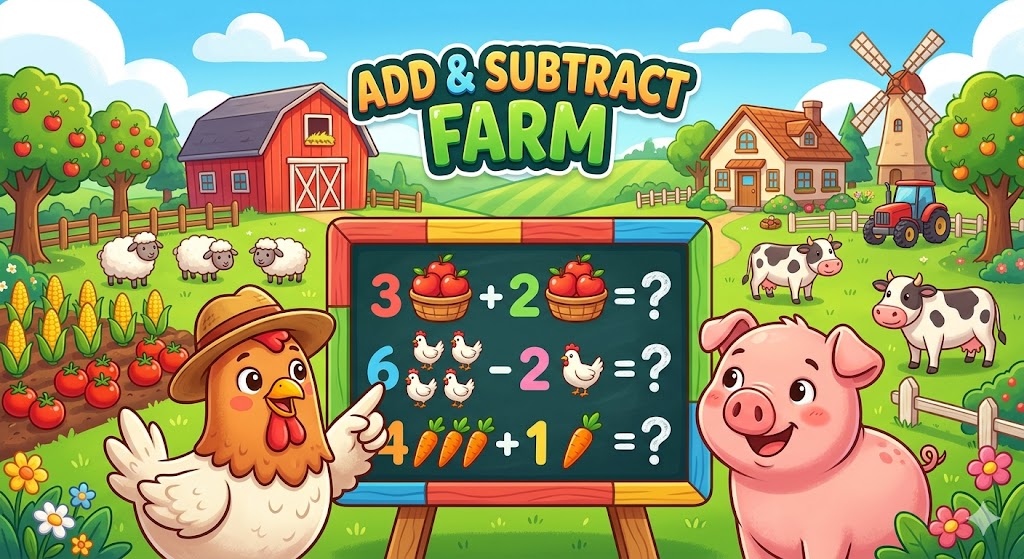
Add & Subtract Farm
Learn addition and subtraction through farm-themed visual puzzles. For ages 5-7, builds number sense and word problem skills. 10-15 min.
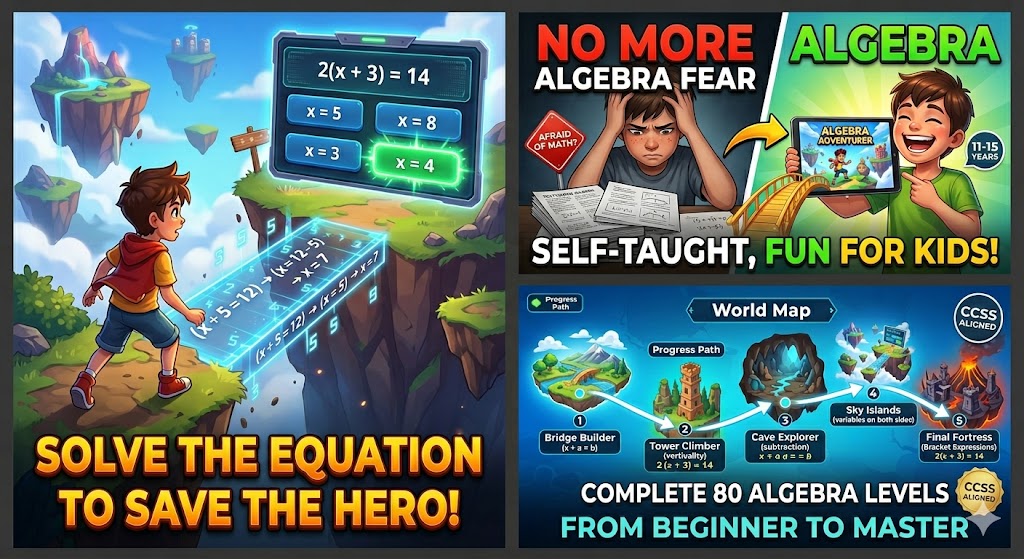
Algebra Adventurer
Master algebra by solving linear equations to build bridges across 5 worlds. For ages 11-15, builds problem solving and mathematical reasoning. 15-20 min.
Coin Collector
Practice money math by collecting coins from pennies to quarters. For ages 5-7, builds addition and place value skills. 10-15 min.
Coordinate Conquest
Explore the coordinate plane by plotting points across all four quadrants. For ages 11-15, builds graphing and linear equation skills. 15-20 min.