📐 Geometry Architect
🕹️ How to Play
-
Look at the blueprint to see what to build.
-
Click a shape from the palette, then click to place it.
-
Match the blueprint as closely as possible!
🧩 Skills You'll Build
📖 About This Game
Become a Geometry Architect! Study the blueprint overlay showing target shape compositions, then select shapes from your palette to recreate the design. Rectangles, triangles, and circles snap to a grid for precision. With 30 levels covering basic placement, rotation, symmetry, area matching, and free design, you’ll master spatial reasoning and geometric thinking.
Learning outcomes: Geometry, Spatial Reasoning, and Measurement development through engaging, self-paced gameplay.
What Your Child Will Learn
Students develop the ability to analyze a geometric design, identify its component shapes, and recreate it through precise placement — building the spatial decomposition skills that support everything from geometry proofs to reading engineering blueprints. The rotation levels introduce students to the idea that shapes can be transformed while retaining their properties, and the symmetry levels build aesthetic and mathematical awareness simultaneously. By the free design level, students apply everything they’ve learned independently.
Skills Developed in Detail
- Geometry: Working with rectangles, triangles, and circles in practical design contexts reinforces properties in a memorable way — students who use triangles to create roofs understand that triangles have a pointed apex better than students who only see them in isolation.
- Spatial Reasoning: Mentally planning where to place the next shape — anticipating how it will fit next to existing shapes — directly exercises the spatial visualization skill that strongly predicts success in mathematics.
- Measurement: Grid-based placement requires students to count grid units and estimate size relationships, building measurement intuition alongside formal shape knowledge.
- Architecture: The blueprint-to-building workflow introduces students to the concept of design representation — that a two-dimensional plan describes a three-dimensional structure — which is foundational to engineering and architecture.
Tips for Parents
Point out architectural geometry on walks or drives: “What shapes make up the roof of that building? How many rectangles do you see on that bridge?” Students who connect classroom geometry to the built world develop stronger spatial reasoning and a more genuine appreciation for mathematical structure. After a game session, ask your child to sketch a building using only the shapes they worked with in the game.
How Teachers Can Use This in the Classroom
Geometry Architect supports upper elementary geometry units on shapes, symmetry, and spatial reasoning. The blueprint-matching format makes it an excellent extension for students who have mastered shape identification and are ready to apply that knowledge in a more complex context. The free design level makes an engaging creative project: students can design and describe their own building using geometric vocabulary.
Curriculum Alignment
- CCSS.MATH.CONTENT.3.G.A.1 — Understand that shapes in different categories may share attributes, and that the shared attributes can define a larger category
- CCSS.MATH.CONTENT.4.G.A.3 — Recognize a line of symmetry for a two-dimensional figure as a line across the figure such that the figure can be folded along the line into matching parts
- CCSS.MATH.CONTENT.5.G.B.4 — Classify two-dimensional figures in a hierarchy based on properties
Why It Matters
Spatial reasoning is one of the strongest predictors of success in STEM fields — stronger, in some studies, than early mathematics scores. Children who develop the ability to visualize, rotate, and compose geometric forms are better positioned to succeed in geometry, physics, engineering, computer science, and virtually every technical field. Architecture Studio makes spatial reasoning development joyful and concrete, giving students a meaningful geometric experience that supports years of future STEM learning.
More Math & Numbers Games
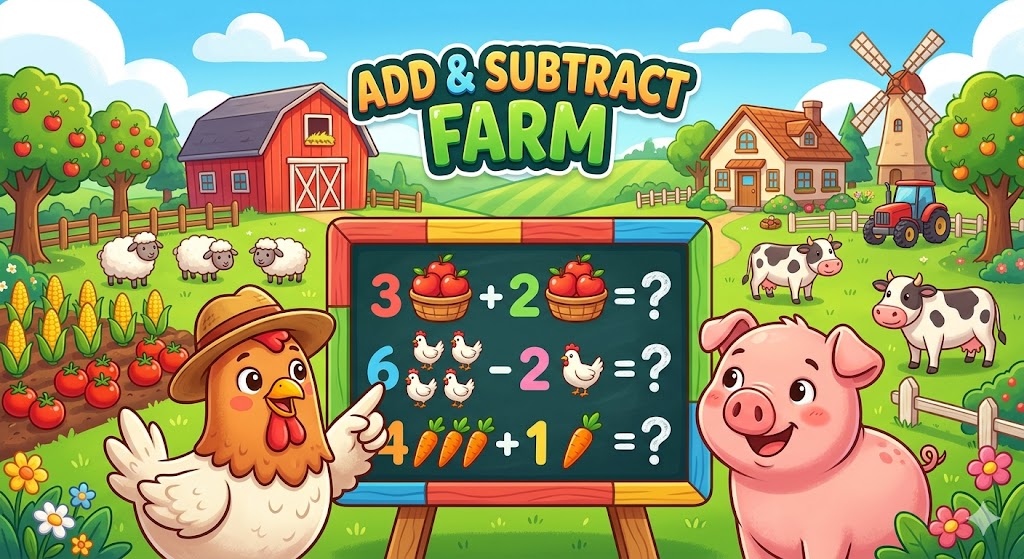
Add & Subtract Farm
Learn addition and subtraction through farm-themed visual puzzles. For ages 5-7, builds number sense and word problem skills. 10-15 min.
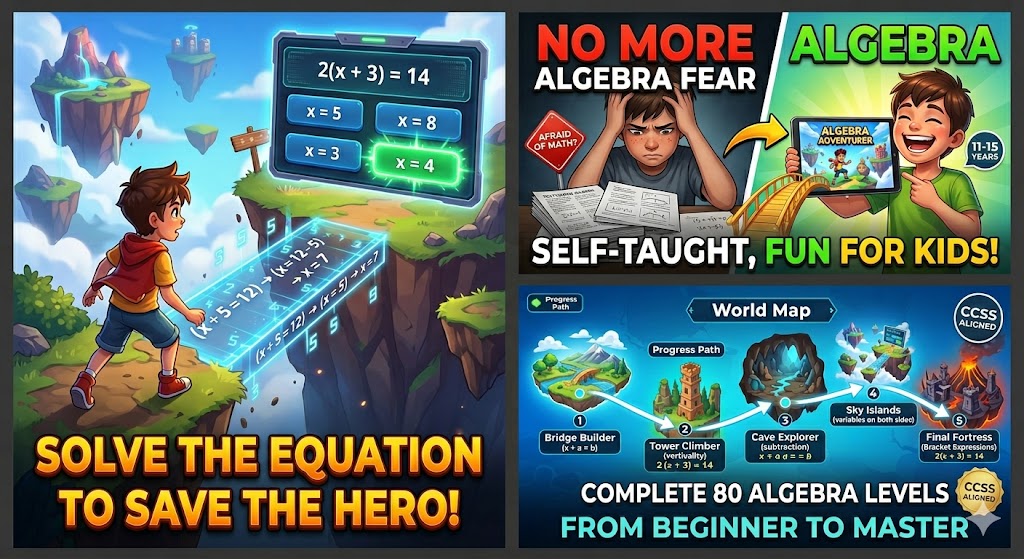
Algebra Adventurer
Master algebra by solving linear equations to build bridges across 5 worlds. For ages 11-15, builds problem solving and mathematical reasoning. 15-20 min.
Coin Collector
Practice money math by collecting coins from pennies to quarters. For ages 5-7, builds addition and place value skills. 10-15 min.
Coordinate Conquest
Explore the coordinate plane by plotting points across all four quadrants. For ages 11-15, builds graphing and linear equation skills. 15-20 min.