🔐 Math Escape Room
🕹️ How to Play
-
Read the math puzzle on the wall.
-
Calculate the answer to get the key code.
-
Enter the code to unlock the door and escape!
🧩 Skills You'll Build
📖 About This Game
Math Escape Room challenges players to solve equations across 30 themed chambers. Each room has a locked door that only opens when you crack the math puzzle. Progress through Addition, Subtraction, Multiplication, Division, and Mixed Operations rooms — each harder than the last. Can you escape all five rooms?
Learning outcomes: Mental Math, Problem Solving, and Equations development through engaging, self-paced gameplay.
What Your Child Will Learn
Students develop mental calculation fluency across the four operations in a context where accuracy is required to proceed — the door only opens when the answer is correct, not “close enough.” The progressively themed chambers introduce each operation in isolation before mixing them, ensuring students don’t confuse the operations when multiple types appear together. By the Mixed Operations chamber, students must correctly identify which operation a problem calls for before computing the answer — an important metacognitive skill.
Skills Developed in Detail
- Mental Math: Working toward each door code without paper tools builds confidence in doing arithmetic in one’s head — an important practical skill and a signal of genuine number fluency.
- Problem Solving: The escape room framing adds genuine urgency and purpose to calculation practice, which changes the psychological experience of solving problems from busywork to meaningful challenge.
- Equations: Reading math puzzles “off the wall” rather than from a textbook positions equations as clues to be solved rather than exercises to be completed, building a more active and purposeful relationship with mathematical notation.
- Logic: The Mixed Operations chamber requires students to parse which operation is needed before calculating — this reading-for-meaning skill is crucial for word problems on every standardized assessment.
Tips for Parents
Play math puzzle games at the dinner table — “I’m thinking of a number. If you add 7 to it you get 15. What’s my number?” These oral equation games build the same mental math and equation-solving skills as the game, in a social, low-pressure context. Times where your child arrives at the answer faster than you (even if you’re being strategically slow) build enormous confidence with mental arithmetic.
How Teachers Can Use This in the Classroom
Math Escape Room is an effective and engaging review activity for grades 3–5 after teaching each of the four operations. Assign the Addition chamber after teaching addition, the Subtraction chamber during review, and so on — saving the Mixed Operations chamber for end-of-unit review before a test. The game’s immediate feedback makes it more efficient than self-graded review worksheets.
Curriculum Alignment
- CCSS.MATH.CONTENT.3.OA.C.7 — Fluently multiply and divide within 100, using strategies such as the relationship between multiplication and division
- CCSS.MATH.CONTENT.4.NBT.B.4 — Fluently add and subtract multi-digit whole numbers using the standard algorithm
- CCSS.MATH.CONTENT.3.OA.D.8 — Solve two-step word problems using the four operations
Why It Matters
Mental arithmetic fluency is not an outdated skill in a calculator world — it is the cognitive infrastructure that makes mathematical reasoning possible. Students who can mentally calculate quickly spend their cognitive resources understanding problems rather than executing procedures, which makes them dramatically better at multi-step problems, estimation, and mathematical reasoning. Mental math fluency is also highly predictive of success on standardized mathematics assessments throughout the school years.
More Math & Numbers Games
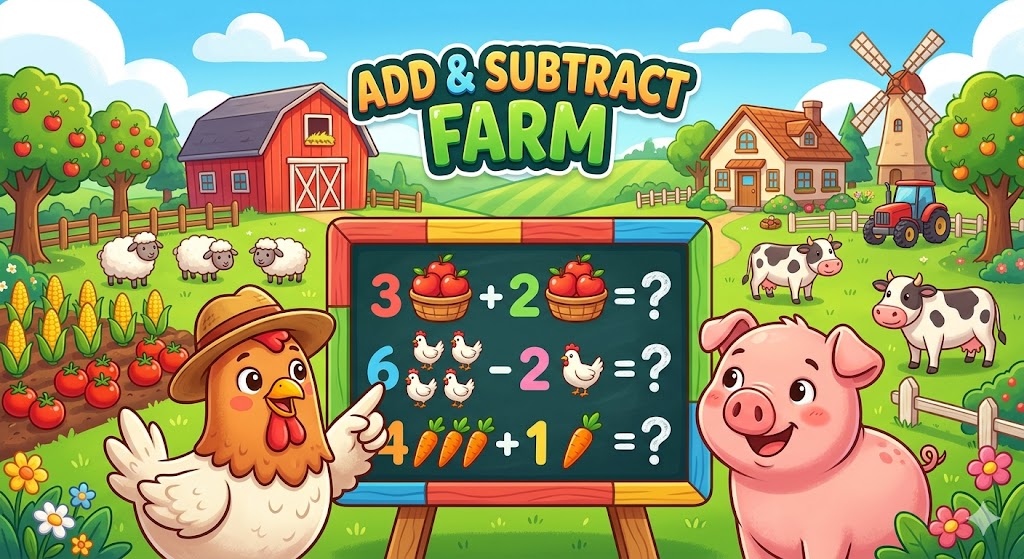
Add & Subtract Farm
Learn addition and subtraction through farm-themed visual puzzles. For ages 5-7, builds number sense and word problem skills. 10-15 min.

Algebra Adventurer
Master algebra by solving linear equations to build bridges across 5 worlds. For ages 11-15, builds problem solving and mathematical reasoning. 15-20 min.
Coin Collector
Practice money math by collecting coins from pennies to quarters. For ages 5-7, builds addition and place value skills. 10-15 min.
Coordinate Conquest
Explore the coordinate plane by plotting points across all four quadrants. For ages 11-15, builds graphing and linear equation skills. 15-20 min.