🎉 Pattern Party
🕹️ How to Play
-
Look at the pattern and find the missing piece.
-
Tap the emoji that completes the pattern.
-
Complete 5 patterns to advance!
Game loading...
🧩 Skills You'll Build
📖 About This Game
Pattern Party teaches young learners to recognize and complete repeating sequences through colorful emoji patterns. Starting with simple two-item color patterns, kids progress through shapes, number sequences, and mixed three-item and four-item patterns that grow increasingly complex. Each level presents five fun pattern puzzles, building critical thinking and logical reasoning skills that form the foundation of mathematical thinking.
Learning outcomes: Pattern Recognition, Sequencing, and Critical Thinking development through engaging, self-paced gameplay.
What Your Child Will Learn
Children develop the ability to identify the repeating unit in a sequence, extend that sequence by predicting the next element, and eventually identify patterns by multiple simultaneous attributes (color AND shape AND size). Starting with simple two-element color patterns (red, blue, red, blue…) and progressing through shape sequences and complex four-element mixed patterns, students build the pattern-recognition fluency that underpins mathematical thinking from number sequences to algebraic rules.
Skills Developed in Detail
- Pattern Recognition: Identifying what comes next in a sequence requires holding the previous elements in mind, finding the rule that governs them, and applying it forward — a direct exercise in inductive reasoning.
- Sequencing: Patterns are inherently sequential — the position of each element relative to others determines the rule — reinforcing the understanding that order carries meaning and determines outcomes.
- Logic: The more complex patterns (three-element, four-element, mixed attribute) require logical analysis: “The shape changes every three emojis, but the color changes every two — so what comes at position 7?” builds explicit logical reasoning.
- Critical Thinking: The game rewards careful observation over guessing — students who rush through simple patterns by guessing are challenged when complex patterns require genuine analysis, building the habit of thinking before answering.
Tips for Parents
Point out patterns everywhere — food packaging, wallpaper, clothing, music, nature (flower petals, pinecone spirals). Ask your child “What’s the repeating unit? What comes next if the pattern continues?” Extending the game into natural pattern observation develops the broad pattern-recognition thinking that benefits all mathematical learning. You can also create patterns together with objects and challenge each other to identify the rule.
How Teachers Can Use This in the Classroom
Pattern Party supports kindergarten and first-grade mathematics units on patterns and algebraic thinking. It works well as a five-minute daily pattern warm-up that builds over a week from simple to complex. The game can also be used as an informal assessment of a student’s pattern-recognition stage — which types of patterns they can handle gives the teacher information about their logical reasoning development.
Curriculum Alignment
- CCSS.MATH.CONTENT.K.MD.B.3 — Classify objects into given categories; count the numbers of objects in each category
- CCSS.MATH.CONTENT.1.OA.D.7 — Understand the meaning of the equal sign, and determine if equations involving addition and subtraction are true or false — pattern structure directly supports this
- NCTM Algebra Standards Pre-K-2 — Recognize, describe, and extend patterns and translate from one representation to another
Why It Matters
Pattern recognition is the cognitive engine of mathematical thinking. Every mathematical structure — number sequences, geometric series, algebraic rules, statistical trends — is a pattern that can be identified, extended, and applied. Children who develop strong pattern recognition in early childhood approach mathematics with curiosity and confidence rather than memorization and anxiety. The habit of looking for regularity and asking “what comes next?” is not just a math skill — it is a scientific and analytical habit of mind that benefits learning in every domain.
More Math & Numbers Games
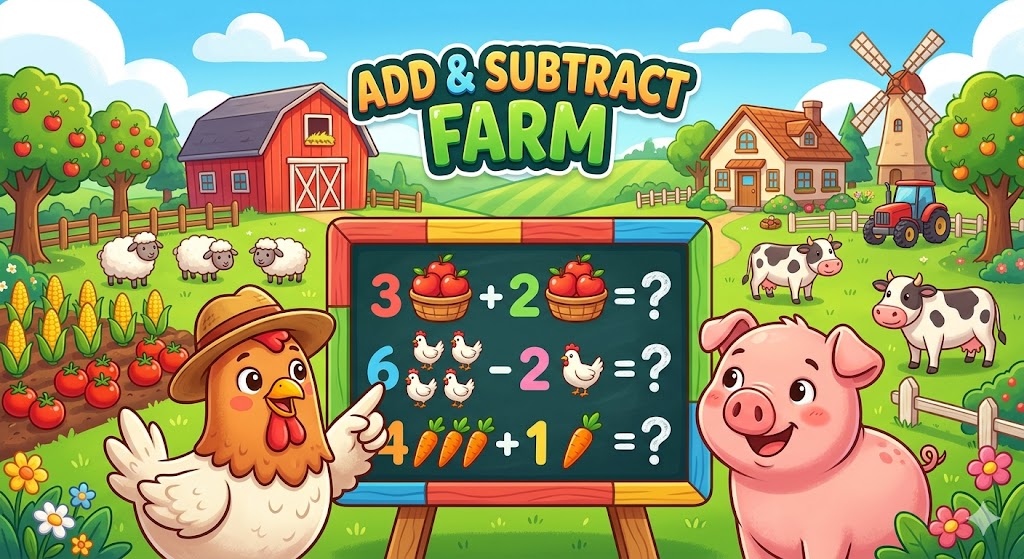
Add & Subtract Farm
Learn addition and subtraction through farm-themed visual puzzles. For ages 5-7, builds number sense and word problem skills. 10-15 min.
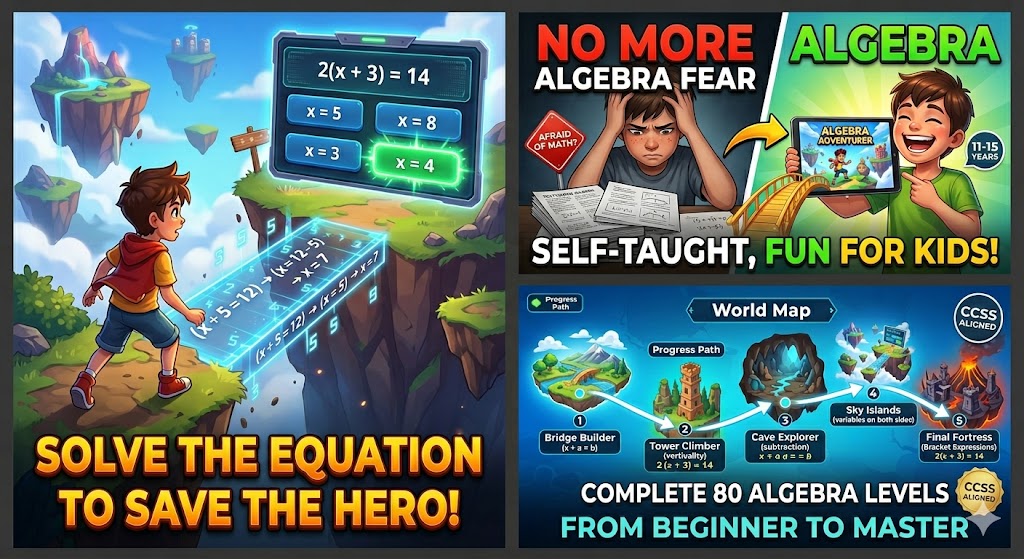
Algebra Adventurer
Master algebra by solving linear equations to build bridges across 5 worlds. For ages 11-15, builds problem solving and mathematical reasoning. 15-20 min.
Coin Collector
Practice money math by collecting coins from pennies to quarters. For ages 5-7, builds addition and place value skills. 10-15 min.
Coordinate Conquest
Explore the coordinate plane by plotting points across all four quadrants. For ages 11-15, builds graphing and linear equation skills. 15-20 min.