⚖️ Ratio & Proportion Lab
🕹️ How to Play
-
Read the target ratio shown.
-
Adjust the beaker amounts to match.
-
Submit to check your proportion!
🧩 Skills You'll Build
📖 About This Game
Master the art of ratios and proportions in this interactive lab! Starting with simple 1:2 and 1:3 ratios, you’ll progress through equivalent ratios, cross multiplication, and real-world applications like recipes and map scales. Adjust virtual lab beakers to match target proportions across 30 levels and 5 lab sections.
Learning outcomes: Ratios, Proportions, and Cross Multiplication development through engaging, self-paced gameplay.
What Your Child Will Learn
Students develop the concept of ratio as a relationship between two quantities — not just a notation — and understand that equivalent ratios describe the same relationship at different scales. The beaker interface makes proportion visual: adjusting one beaker quantity while maintaining the correct ratio requires students to reason proportionally before calculating. By the real-world application levels involving recipes and map scales, students can solve proportion problems that arise in genuinely practical contexts.
Skills Developed in Detail
- Ratios: Understanding that a ratio describes a fixed relationship (every 2 cups of flour requires 1 cup of water, regardless of batch size) builds the proportional reasoning that is one of the most powerful mathematical tools of the middle school years.
- Proportions: Setting up and solving a proportion — finding the unknown quantity that maintains the given ratio — is the central algebraic skill of grades 6–7, and the beaker visualization makes the abstract equation a physical reality.
- Cross Multiplication: The procedural technique of cross-multiplication is introduced after students understand proportions conceptually, ensuring the algorithm is grounded in understanding rather than mechanical execution.
- Problem Solving: Real-world proportion applications (recipe scaling, map distance calculation, speed and distance) give the mathematical skill genuine purpose and make the conceptual understanding transfer to novel situations.
Tips for Parents
Cook together using ratios: if a recipe serves 4 and you need to serve 6, calculate the adjusted quantities together. “The ratio of flour to sugar is 2:1 — if we need 3 cups of flour, how much sugar?” This is precisely the proportional reasoning the game builds, applied to a delicious and immediate real-world context. Map reading is another rich application: “The scale says 1 inch equals 10 miles — how many miles is it from this city to that one?”
How Teachers Can Use This in the Classroom
Ratio & Proportion Lab is a strong supplementary practice tool for grades 6–7 mathematics. The five lab sections map to the natural instructional sequence: simple ratios, then equivalent ratios, then cross multiplication, then real-world applications. The visual beaker interface makes an excellent whiteboard demonstration tool — teachers can project the game and have students predict the beaker adjustment before the teacher inputs the value.
Curriculum Alignment
- CCSS.MATH.CONTENT.6.RP.A.1 — Understand the concept of a ratio and use ratio language to describe a ratio relationship between two quantities
- CCSS.MATH.CONTENT.6.RP.A.3 — Use ratio and rate reasoning to solve real-world and mathematical problems
- CCSS.MATH.CONTENT.7.RP.A.2 — Recognize and represent proportional relationships between quantities
Why It Matters
Proportional reasoning is the most important mathematical concept of the middle school years, and difficulty with it is one of the strongest predictors of trouble with algebra, geometry, and statistics in high school. Students who genuinely understand ratios and proportions — not just the cross-multiply procedure — handle percentages, similar triangles, unit conversions, probability, and linear equations with far greater confidence. This understanding doesn’t just help in math class; it supports virtually every quantitative reasoning task students face throughout their education and adult lives.
More Math & Numbers Games
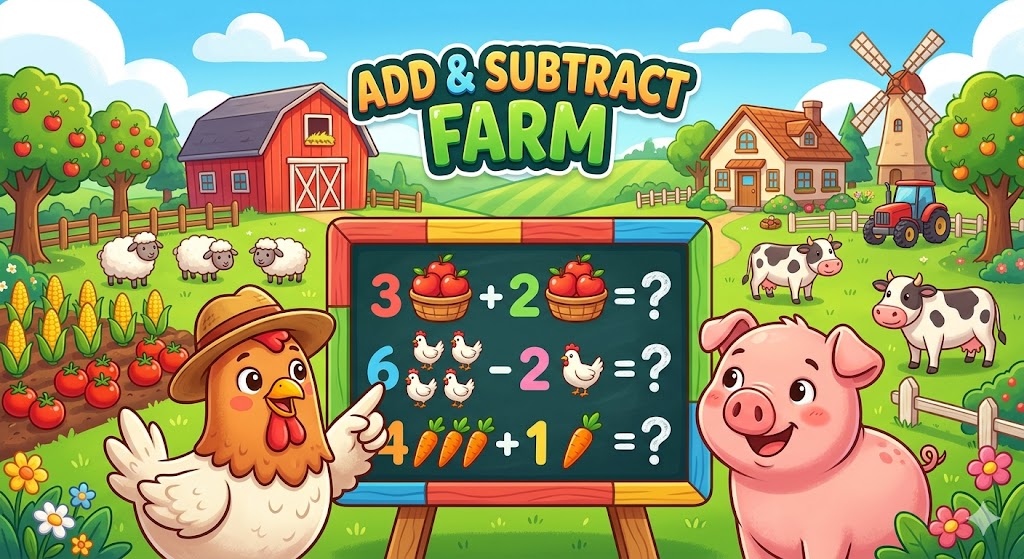
Add & Subtract Farm
Learn addition and subtraction through farm-themed visual puzzles. For ages 5-7, builds number sense and word problem skills. 10-15 min.

Algebra Adventurer
Master algebra by solving linear equations to build bridges across 5 worlds. For ages 11-15, builds problem solving and mathematical reasoning. 15-20 min.
Coin Collector
Practice money math by collecting coins from pennies to quarters. For ages 5-7, builds addition and place value skills. 10-15 min.
Coordinate Conquest
Explore the coordinate plane by plotting points across all four quadrants. For ages 11-15, builds graphing and linear equation skills. 15-20 min.