🔷 Shape Shifter
🕹️ How to Play
-
Watch for obstacles with shape-holes approaching.
-
Tap the matching shape button to transform.
-
Pass through all obstacles to complete the level!
🧩 Skills You'll Build
📖 About This Game
Transform into shapes to zoom through obstacles in Shape Shifter! Your character auto-walks right while walls with shape-holes rush toward you. Tap the correct shape button — circle, square, or triangle — to transform before impact. With 30 levels across five worlds from single shapes to high-speed mixed runs, it’s the perfect blend of geometry and quick reflexes.
Learning outcomes: Shapes, Geometry, and Pattern Recognition development through engaging, self-paced gameplay.
What Your Child Will Learn
Children develop rapid, automatic shape recognition — the ability to identify a circle, square, or triangle at a glance — which is a fundamental geometry prerequisite. The time-pressure mechanic trains the kind of quick visual processing that makes shape identification automatic rather than effortful. By the high-speed mixed runs of the final world, students recognize all three shapes without hesitation, freeing up cognitive resources for the more complex geometry concepts they will encounter in later grades.
Skills Developed in Detail
- Shapes: Automatic shape recognition is to geometry what letter recognition is to reading — it is the perceptual foundation that everything else builds on. Shape Shifter’s gameplay directly builds this automation through repeated, successful recognition.
- Geometry: Understanding that circles, squares, and triangles are distinct shapes with different properties — and that the distinction matters in the real world — develops the beginning of geometric classification thinking.
- Reflexes: The reaction-time component of the game develops visual processing speed, which is an important component of perceptual fluency relevant to reading, mathematics, and general cognitive performance.
- Pattern Recognition: The alternating shape sequences in mixed runs require students to anticipate which shape is coming next based on the recent pattern, building predictive visual processing alongside reactive recognition.
Tips for Parents
Play a quick shape-identification game during any car trip or walk: “How many circles can you find? How many rectangles?” This extends shape recognition into the built and natural world, building the habit of geometric observation that makes the world feel legible and organized. Ask “Why is a wheel a circle? Why is a door a rectangle?” — connecting shape properties to practical design encourages geometric reasoning.
How Teachers Can Use This in the Classroom
Shape Shifter works well as a brief, energizing brain break during kindergarten math lessons — three to five minutes of the game after a seated activity provides variety while reinforcing the shape vocabulary being taught. The increasing difficulty across five worlds allows teachers to use early worlds as simple review and later worlds as a challenge for students who have mastered basic shape identification. The reaction-time element makes it naturally motivating as a class high-score competition.
Curriculum Alignment
- CCSS.MATH.CONTENT.K.G.A.2 — Correctly name shapes regardless of their orientations or overall size
- CCSS.MATH.CONTENT.K.G.A.3 — Identify shapes as two-dimensional (flat) or three-dimensional (solid)
- CCSS.MATH.CONTENT.1.G.A.2 — Compose two-dimensional shapes to create a composite shape
Why It Matters
Automatic shape recognition is the perceptual foundation of all geometry education. Students who can identify circles, squares, and triangles instantly can focus their attention on the properties of those shapes, their relationships, and their applications — rather than spending cognitive resources on basic identification. Shape fluency, like letter fluency in reading, is built through repeated, successful practice that makes recognition effortless. Shape Shifter delivers this practice in the most engaging format possible: urgent, rewarding, and visually immediate.
More Math & Numbers Games
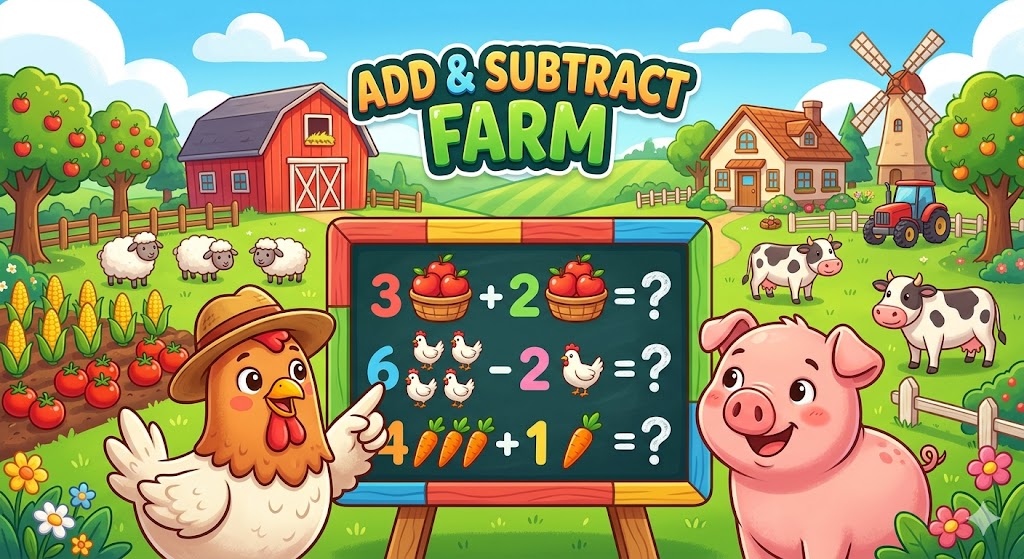
Add & Subtract Farm
Learn addition and subtraction through farm-themed visual puzzles. For ages 5-7, builds number sense and word problem skills. 10-15 min.

Algebra Adventurer
Master algebra by solving linear equations to build bridges across 5 worlds. For ages 11-15, builds problem solving and mathematical reasoning. 15-20 min.
Coin Collector
Practice money math by collecting coins from pennies to quarters. For ages 5-7, builds addition and place value skills. 10-15 min.
Coordinate Conquest
Explore the coordinate plane by plotting points across all four quadrants. For ages 11-15, builds graphing and linear equation skills. 15-20 min.