📈 Statistics Simulator
🕹️ How to Play
-
Look at the dataset numbers.
-
Calculate the requested statistic.
-
Select the correct answer!
🧩 Skills You'll Build
📖 About This Game
Become a data detective! Statistics Simulator presents real datasets and challenges you to calculate mean, median, mode, and range. Progress through 4 modules covering each statistic individually before tackling mixed challenges. Visual bar charts help you see the data, but the math is all yours.
Learning outcomes: Mean, Median, and Mode development through engaging, self-paced gameplay.
What Your Child Will Learn
Students learn to calculate and interpret all four measures of central tendency and spread: mean (the arithmetic average), median (the middle value when data is ordered), mode (the most frequently occurring value), and range (the difference between the highest and lowest values). They develop understanding of not just how to compute each measure but what it tells them about the data — when is the mean misleading? when is the median more informative? The bar chart visualization helps students see the data structure behind the numbers.
Skills Developed in Detail
- Mean: Calculating the mean requires summing all values and dividing by the count — building procedural fluency with multi-step arithmetic in a meaningful context. Students also learn that the mean can be skewed by extreme values.
- Median: Finding the median requires ordering data and identifying the middle value (or the average of the two middle values for even-sized datasets), building a systematic approach to data organization.
- Mode: The most concretely intuitive measure — the most frequent value — introduces students to frequency-based analysis and connects naturally to the bar charts that make frequency visible.
- Range: Calculating range as maximum minus minimum introduces the concept of data spread alongside central tendency, giving students their first tool for describing how varied a dataset is.
Tips for Parents
Calculate statistics from real data together — sports scores, weekly temperatures, test grades (if your student is comfortable sharing). Ask “What does the mean tell us? Is there a value that’s pulling the mean higher or lower than most of the data?” These conversations connect the abstract statistical formulas to the actual information they convey about real-world datasets. Sports statistics provide particularly engaging real-world application.
How Teachers Can Use This in the Classroom
Statistics Simulator is a strong supplementary practice tool for grades 6–8 during statistics units. Assign each module (mean, median, mode, range) after teaching each measure in class, using the game as a practice consolidation activity. The mixed module is well suited as a review assignment before a statistics quiz or test. The bar chart visualization makes the game particularly useful for visual learners who benefit from seeing the distribution before calculating.
Curriculum Alignment
- CCSS.MATH.CONTENT.6.SP.B.5c — Giving quantitative measures of center (median and/or mean) and variability (interquartile range and/or mean absolute deviation)
- CCSS.MATH.CONTENT.7.SP.A.1 — Understand that statistics can be used to gain information about a population by examining a sample of the population
- CCSS.MATH.CONTENT.6.SP.A.3 — Recognize that a measure of center for a numerical data set summarizes all of its values with a single number, while a measure of variation describes how its values vary with a single number
Why It Matters
Statistical thinking is one of the most directly practical mathematical skills a person can develop — it is used to evaluate medical studies, sports analytics, business decisions, political polling, and scientific research. Students who can calculate and interpret descriptive statistics are equipped to engage critically with any quantitative claim they encounter, whether in a newspaper, a job interview, or a scientific study. Statistics literacy is increasingly essential in a data-saturated world where the ability to question averages and understand variation separates informed consumers of information from passive ones.
More Math & Numbers Games
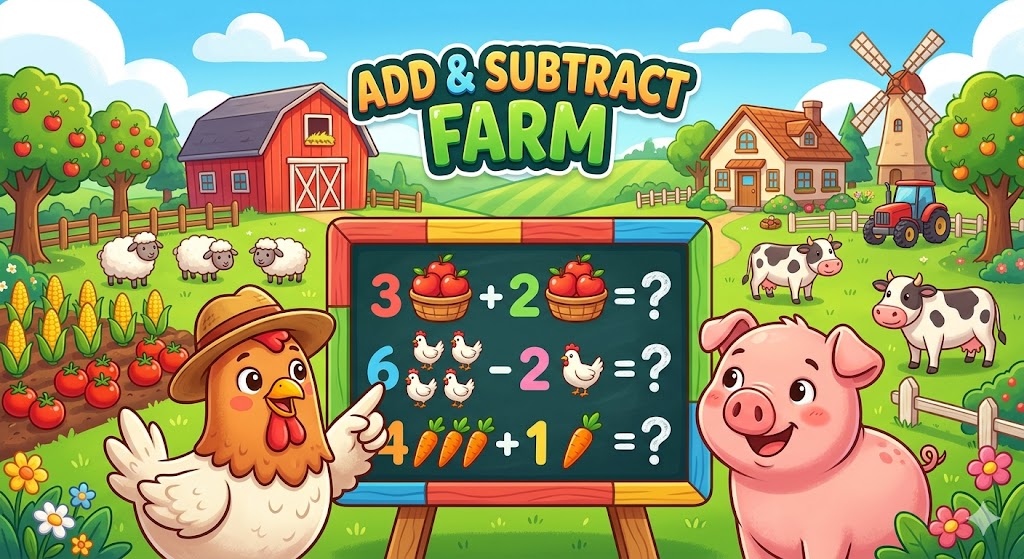
Add & Subtract Farm
Learn addition and subtraction through farm-themed visual puzzles. For ages 5-7, builds number sense and word problem skills. 10-15 min.
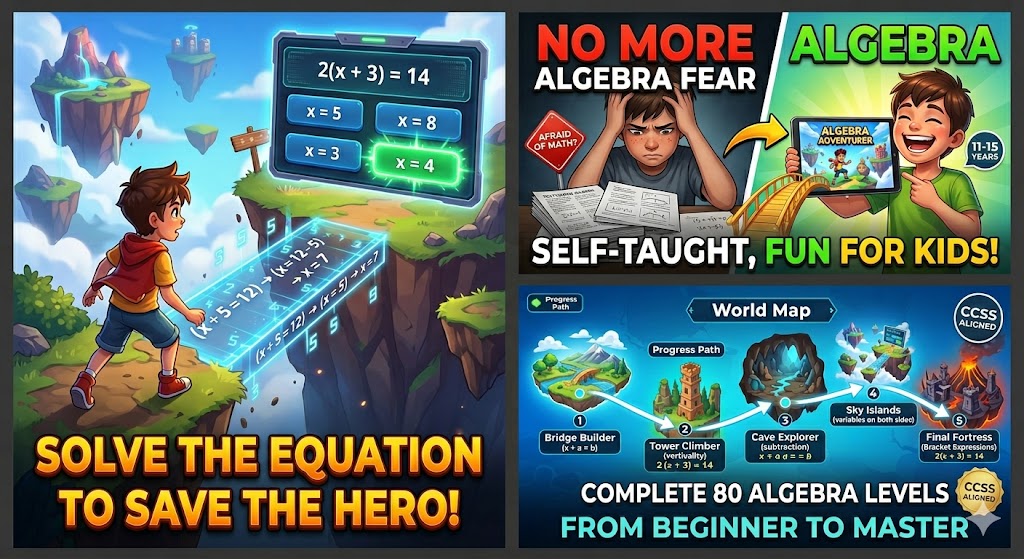
Algebra Adventurer
Master algebra by solving linear equations to build bridges across 5 worlds. For ages 11-15, builds problem solving and mathematical reasoning. 15-20 min.
Coin Collector
Practice money math by collecting coins from pennies to quarters. For ages 5-7, builds addition and place value skills. 10-15 min.
Coordinate Conquest
Explore the coordinate plane by plotting points across all four quadrants. For ages 11-15, builds graphing and linear equation skills. 15-20 min.